
Filing Guide · 2025 Edition
Annual GST Return Filing 2025: 7 Proven Steps to Avoid Penalties
Your Annual GST Return isn't just paperwork — it's the one document that decides whether your financial year closes clean or lands you a notice. Here's the plain-English playbook a good consultant would walk you through.

Table of Contents
01 .
What is an Annual GST Return?
02.
Who needs to file it?
03.
Why it deserves your attention
04.
The pre-filing checklist
05.
Common mistakes to avoid
06.
Due dates & late fees
07.
Final thoughts
Filing your Annual GST Return isn't another box to tick before the financial year shuts. It's the one document that pulls together every sale, purchase and tax credit you've reported through the year — and get it wrong, and the department will let you know.
Here's the honest, no-jargon version of what an Annual GST Return actually is, who has to file one, and how to make sure yours goes through without a notice landing in your inbox two months later.
1. What is an Annual GST Return Filing?
Think of the Annual GST Return as the year-end summary of everything you've already told the department. All those monthly and quarterly filings — GSTR-1, GSTR-3B, your inward supplies, your input tax credits — get rolled up into one comprehensive statement filed as GSTR-9 (and GSTR-9C for businesses above a specified turnover).
In one line: the Annual GST Return is GST's way of asking, "does everything you reported through the year actually add up?"
2. Who actually needs to file theAnnual GST Return Filing ?
Not every registered business has to file every form. The general breakdown:
01. GSTR-9 — Mandatory for regular taxpayers, with relaxations for smaller businesses depending on the turnover threshold notified for that year.
02. GSTR-9A — Applies to taxpayers under the Composition Scheme (this one has changed over recent years, so verify current applicability).
03. GSTR-9C — A reconciliation statement for businesses above a specified turnover; it needs to be certified before submission.
3. Why businesses shouldn't treat it casually
A lot of owners treat the Annual GST Return as a formality — copy the numbers over, hit submit, move on. That's exactly where things go sideways.
The Annual GST Return isn't a summary; it's a reconciliation. It compares what you filed month after month against what your books actually say. If the input tax credit in your books doesn't match what shows up in your GSTR-3B filings, that gap doesn't quietly disappear — it becomes a red flag.
Interest & penalty
On any under-reported tax that surfaces during reconciliation.
ITC reversal
Wrongly claimed input tax credit can be reversed with interest.
Departmental audits
Mismatches often trigger scrutiny and formal notices.
Assessment trouble
Loss of credibility with your GST officer for future years.
4. Pre-filing checklist for yourAnnual GST Return Filing
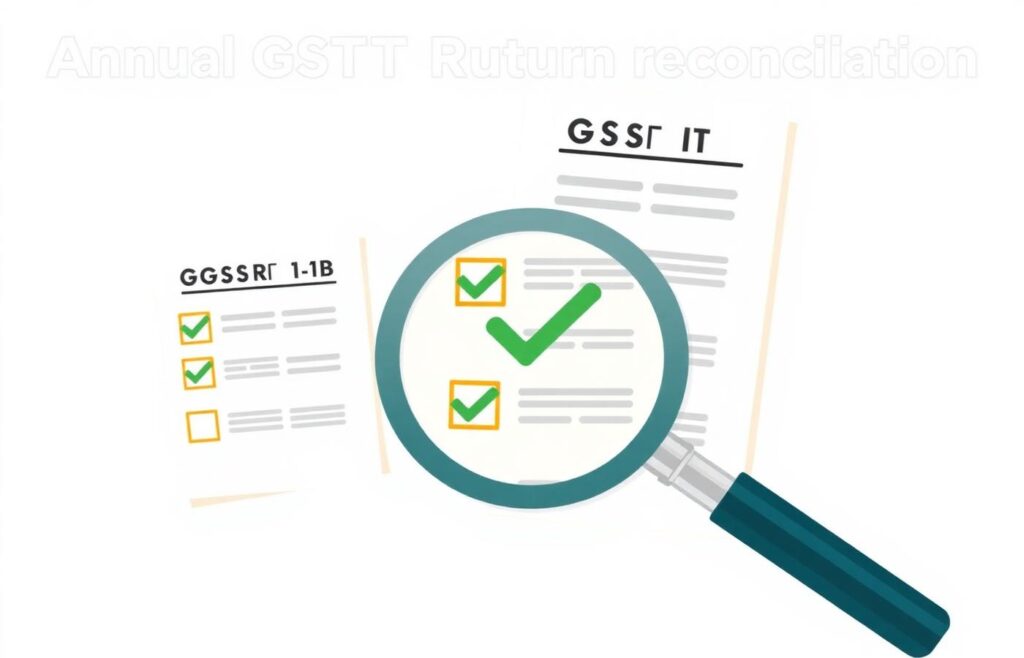
Before you sit down to actually file, pull these essentials together:
01. Reconcile GSTR-1 and GSTR-3B for the full year — outward supplies should match.
02. Match Input Tax Credit claimed in GSTR-3B with your purchase register and GSTR-2B / 2A.
03. Verify the HSN-wise summary of goods and services supplied.
04. Check all amendments and credit / debit notes issued during the year — confirm they're captured correctly.
05. Cross-check turnover as per books against turnover reported in your GST returns.
06. Review any late fees, interest or demand payments made during the year.
Doing this reconciliation early — not the week before the due date — saves you from the last-minute panic that leads to the most expensive errors.
5. Common mistakes businesses make
01. Filing the Annual GST Return without reconciling it against audited financials.
02. Ignoring mismatches between GSTR-2A / 2B and the ITC actually claimed.
03. Overlooking the impact of credit and debit notes on annual turnover.
04. Missing amendments made in later months that belong against the original year.
05. Waiting until the last date — rushed filing is where the costly errors hide.
6. Due dates and late fees
The due date for the Annual GST Return typically falls at the end of the calendar year following the financial year in question. The government has extended the deadline in past years — but banking on an extension is a bad strategy. Miss the date and you're looking at late fees per day of delay, plus interest on any tax shortfall.
7. Final thoughts on your Annual GST Return
Your Annual GST Return isn't about filing one more form. It's about handing your business a clean, reconciled tax record that protects you from future disputes and keeps your compliance history genuinely strong.
A little discipline in reconciling your numbers before you file goes a long way in avoiding notices, penalties and stress you didn't sign up for. And if your books and your GST filings don't naturally sync through the year, the Annual GST Return is where that mismatch shows up — so get a professional to review your reconciliation before you hit submit.
Free 30-minute review
Let SNR Tax Care review your Annual GST Return Filing before you file.
We'll walk through your GSTR-9 reconciliation, flag mismatches, and make sure you close the year without a notice.
Ready to Get Started? Let's Talk Today
Looking for a reliable Tax Consultant in Visakhapatnam? Contact SNR TaxCare today for expert tax and compliance support.
- +91 996 666 5334
- +91 703 666 5334
- snrtaxcare5334@gmail.com
- Monday – Saturday: 9:00 AM – 7:00 PM