
Focus Keyword · TDS Registration
TDS Registration in India :
6 Easy Steps to Get TAN Fast
(2026 Guide)
A complete, no-jargon walkthrough of TDS Registration — who needs it,
the documents to keep ready, and exactly how to file Form 49B and receive your TAN.
the documents to keep ready, and exactly how to file Form 49B and receive your TAN.
- Read time · 9 min
- Updated · Jul 2026
- Applies to · Companies, firms & individuals
TDS Registration is the process every deductor in India must complete before deducting tax at source — it results in a 10-digit TAN (Tax Deduction and Collection Account Number) issued by the Income Tax Department. Without it, you legally cannot deduct, deposit, or report TDS.
On this page
01. What is TDS & why TDS Registration matters
02 .Who needs TDS Registration
03 .Documents required for TDS Registration
04 .Step-by-step TDS Registration process
05 .After TDS Registration: ongoing compliance
06 .TDS rate chart
07 .Key deadlines
08 .Penalty for skipping TDS Registration
09 .FAQs
01 · Basics
What is TDS, and Why Does TDS Registration Matter?
TDS (Tax Deducted at Source) is a pay-as-you-earn mechanism: whoever pays you — an employer, a bank, a client — deducts a slice of tax before the money reaches you, and deposits it with the government on your behalf. It keeps tax collection steady through the year instead of one lump sum at filing time.
To legally deduct that tax, the payer first needs a TAN. Completing TDS Registration is simply the act of applying for and receiving this TAN. Think of TAN as the "ID card" the Income Tax Department checks every time TDS is deposited or reported.
In short: TDS Registration = applying for TAN through Form 49B. Once granted, that TAN must be quoted on every TDS challan, return, and certificate you issue.
02 · Eligibility
Who Needs TDS Registration?
You need to register for TDS if you regularly make payments that cross these common thresholds:
1. Salary payments above the basic exemption limit
2. Rent above ₹2.4 lakh a year
3. Professional or technical fees above ₹30,000
4. Contractor payments above ₹30,000 (single) or ₹1 lakh (aggregate)
5. Interest on fixed deposits above ₹40,000 (₹50,000 for senior citizens)
This covers private companies, LLPs and partnership firms, government offices and PSUs, banks and NBFCs, and individuals or professionals whose turnover exceeds ₹1 crore (business) or ₹50 lakh (profession).
Example
ABC Pvt. Ltd. pays Mr. Ravi an annual salary of ₹8 lakh. Because that crosses the exemption limit, the company is required to deduct TDS — which means it must first obtain a TAN through this process.
03 · Paperwork
Documents Required for TDS Registration
For companies and firms
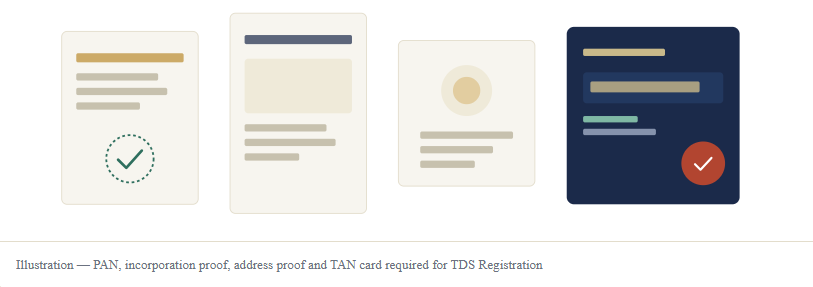
1. PAN of the entity
2. Certificate of Incorporation (companies) or Partnership Deed (firms)
3. Registered office address proof
4. PAN and ID proof of the authorised signatory
For individuals with business income
1. PAN card
2. Aadhaar card
3. Business address proof (electricity bill or lease agreement)
04 · Walkthrough
Step-by-Step TDS Registration Process
01. Determine eligibility
Check whether the payments you make — salary, rent, professional fees, contractor payments, FD interest — cross the thresholds that trigger TDS. If they do, registering for a TAN is mandatory before you make the payment.
02. Gather your documents
Keep entity PAN, incorporation or partnership proof, address proof, and the authorised signatory's identity documents ready before you start the online form.
03. Fill Form 49B online
Example :
ABC Pvt. Ltd. selects "Company", enters its registered name as printed on its PAN card, and fills in its Mumbai office address.
04. Submit and pay the fee
Submit Form 49B online and pay the application fee — ₹65 plus 18% GST, roughly ₹77 — by net banking, debit or credit card. You'll get a 14-digit acknowledgement number to track your application status.
05. Receive your TAN
TAN is usually allotted within 7–15 working days. Track status online with your acknowledgement number; the physical TAN card is also posted to your registered address.
05 · What's next
After TDS Registration: Ongoing Compliance
Getting your TAN is only the beginning, not the end, of the obligation. Once your TAN is active, you must:
1. Deduct TDS at the correct rate at the time of payment
2. Deposit it with the government by the 7th of the following month using Challan 281
3. File quarterly TDS returns — Form 24Q for salary, Form 26Q for other payments
4. Issue TDS certificates to deductees — Form 16 for salary, Form 16A for everything else
Example :
ABC Pvt. Ltd. deducts ₹12,000 TDS from Mr. Ravi's April salary, deposits it by 7 May using Challan 281 against its TAN, and files Form 24Q for Q1 by 31 July.
06 · Reference
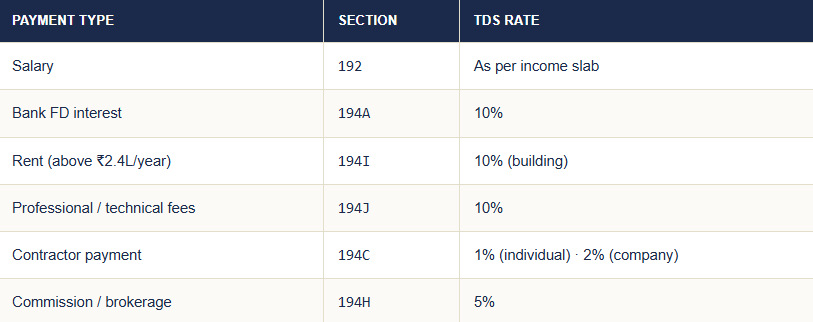
TDS Rate Chart for Common Payments
Rates applicable once your TAN is active
07 · Calendar
Key Deadlines to Remember
TDS deducted in any month is due by the 7th of the following month, except for March, where the deadline extends to 30 April. Quarterly returns follow this calendar:
Q1 (Apr–Jun)
31 Jul
Q2 (Jul–Sep)
31 Oct
Q3 (Oct–Dec)
31 Jan
Q4 (Jan–Mar)
31 May
08 · Risk
Penalty for Skipping TDS Registration
TDS deducted in any month is due by the 7th of the following month, except for March, where the deadline extends to 30 April. Quarterly returns follow this calendar:
Non-compliance is expensive
Failing to obtain a TAN attracts a flat penalty of ₹10,000 under Section 272BB. Delaying TDS deduction or deposit adds interest of 1–1.5% per month, and the related business expense may be disallowed in your income tax computation — meaning you lose the deduction entirely.
09 · FAQ
Penalty for Skipping TDS Registration
Is TDS Registration the same as TAN registration?
Yes. TDS Registration and TAN registration refer to the same process — applying through Form 49B to receive your 10-digit Tax Deduction and Collection Account Number.
How long does TDS Registration take?
Most applicants receive their TAN within 7 to 15 working days of submitting Form 49B and paying the fee.
What does the TAN application cost?
The Form 49B application fee is ₹65 plus 18% GST — approximately ₹77 in total.
Can an individual apply for a TAN?
Yes — individuals with business or professional income above the prescribed turnover limits, or anyone required to deduct TDS on specified payments, can and must apply.
Let SNR Tax Care handle your TDS Registration
From Form 49B filing to quarterly returns and Form 16A issuance, our team manages the entire TAN registration and compliance cycle so you don't have to track deadlines yourself.
Ready to Get Started? Let's Talk Today
Looking for a reliable Tax Consultant in Visakhapatnam? Contact SNR TaxCare today for expert tax and compliance support.
- +91 996 666 5334
- +91 703 666 5334
- snrtaxcare5334@gmail.com
- Monday – Saturday: 9:00 AM – 7:00 PM