7 Essential Bookkeeping & Accounts
Maintenance
Tips Every Business Must Know

Master bookkeeping from basics to advanced — journal entries,
ledger posting, trial balance & GST records. Your complete guide
from SNR TaxCare experts.
Bookkeeping is the backbone of every successful business. Whether you run a small shop
or a growing company, proper bookkeeping and accounts maintenance ensures you stay
compliant, profitable, and financially healthy. This guide by SNR TaxCare covers everything from
the golden rules to practical examples — so you can manage your accounts with confidence.
📋 Table of Contents
1. What is Bookkeeping?
2. Basic Concepts: Assets, Liabilities & Capital
3. Single Entry vs Double Entry Bookkeeping
4. The 3 Golden Rules of Debit & Credit
5. Books of Accounts You Must Maintain
6. Journal Entries & Ledger Posting
7. Trial Balance & Final Accounts
8. Day-to-Day Accounts Maintenance Practices
9. Common Bookkeeping Mistakes to Avoid
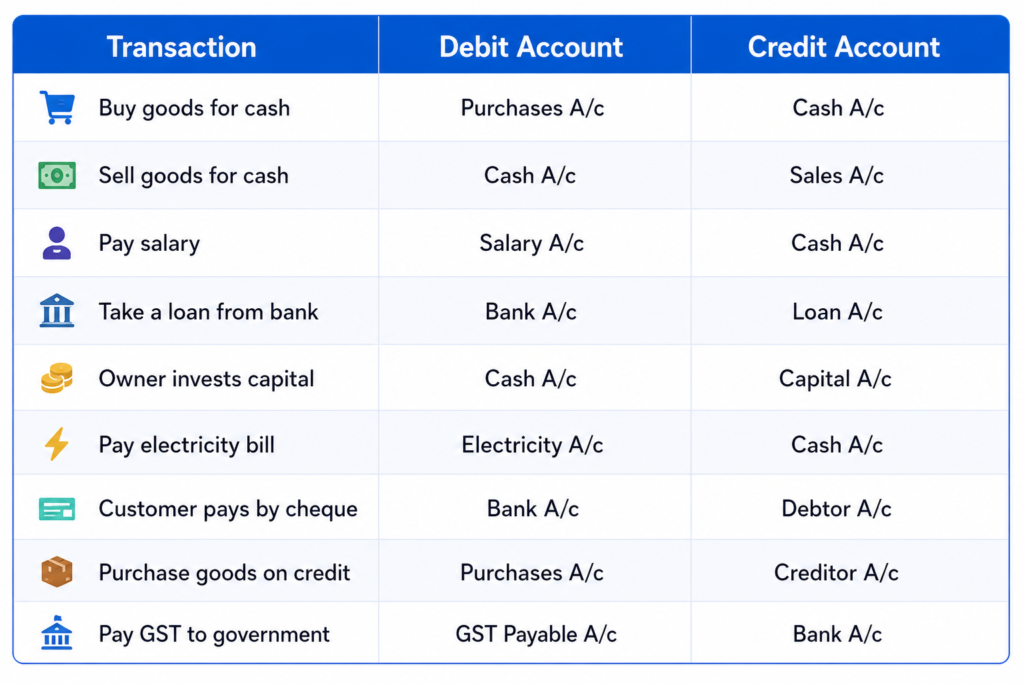
10. Quick Reference: What Goes Where?

What is Bookkeeping?

Bookkeeping is the systematic process of recording all financial transactions of a business in an organized, accurate, and consistent manner. It forms the foundation of accounting and financial management. Every rupee that comes in or goes out of your business must be recorded — this is the core principle of bookkeeping and accounts maintenance.
Without proper bookkeeping, it becomes impossible to understand your business's financial health, file accurate GST returns, or make smart business decisions. SNR TaxCare helps hundreds of businesses across India maintain error-free books every year.

Bookkeeping: Recording Every Business Transaction

Accounts ledger • Journal entries • Financial records

Basic Concepts in Bookkeeping

Before you start maintaining accounts, you need to understand these five
fundamental concepts:
🏗️
Assets
Things your business owns — cash,
equipment, vehicles, buildings, stock.
💳
Liabilities
Things your business owes — loans, unpaid bills, credit from suppliers.
👤
Capital / Equity
The owner's investment in the business. What remains after paying liabilities.
💰
Income / Revenue
Money earned from selling goods or services to customers.
📉
Expenses
Money spent to run your business — rent, salary, electricity, etc.

The Golden Accounting Equation

This equation is the heart of all bookkeeping. It must always balance:

Assets = Liabilities + Capital

Single Entry vs Double Entry Bookkeeping

There are two systems of bookkeeping — the right choice depends on your business
size and complexity:

1. Single Entry System

Simple and suitable for very small businesses. Only income and expenses are recorded. No requirement to track every account — but it's incomplete and not recommended for tax compliance or business growth.

2. Double Entry System ✅ Recommended

Every transaction affects at least two accounts — one is Debited, another is Credited. This is the internationally accepted professional standard used for GST filing, income tax, and audits in India. SNR TaxCare always recommends and follows the double-entry system.

The 3 Golden Rules of Bookkeeping — Debit & Credit
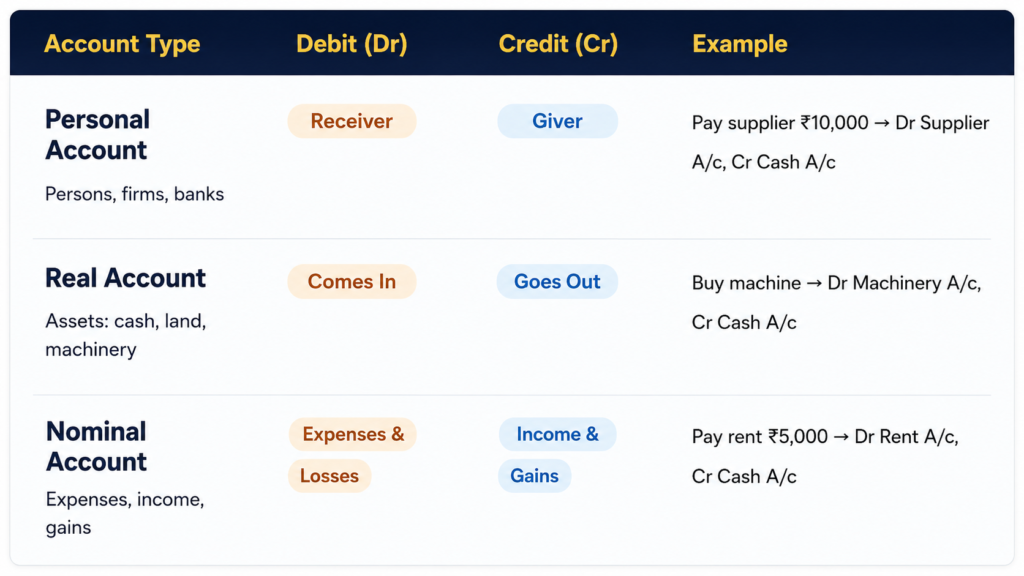
The three golden rules of bookkeeping tell you when to Debit and when to Credit each type of account:
The 3 Golden Rules of Bookkeeping — Debit & Credit

3 Golden Rules of Debit & Credit

Personal • Real • Nominal Accounts

Books of Accounts You Must Maintain

Proper accounts maintenance requires keeping the following books of accounts updated daily:
Journal (Day Book)
The book of first entry. Record every transaction chronologically as it happens, day by day, with date, accounts affected, and narration.
Ledger
The book of final entry. A separate T-Account page for every person, asset, expense, or income. All journal entries are posted here.
Cash Book
A special journal that records only cash and bank transactions. Essential for daily cash management and bank reconciliation.
Purchase Book
Records all credit purchases — goods bought on credit from suppliers. Helps track payables accurately.
Sales Book
Records all credit sales — goods sold on credit to customers. Helps track receivables and GST output.
Additionally, maintain a Purchase Returns Book (goods returned to suppliers) and a Sales Returns Book (goods returned by customers) for complete accounts maintenance.

Journal Entries & Ledger Posting — Practical Examples

Step 1: Create a Journal Entry
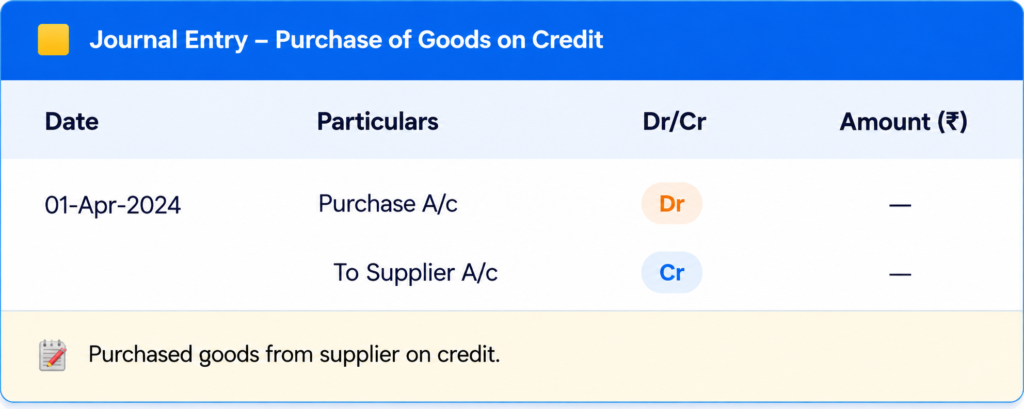
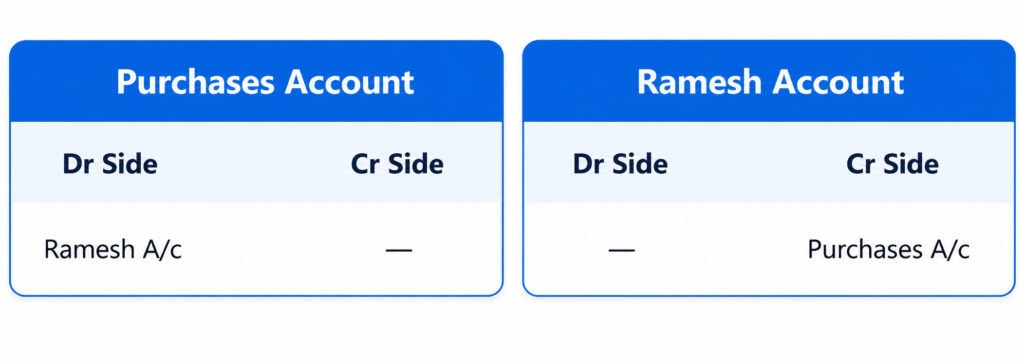
When your business buys goods worth ₹20,000 on credit from Ramesh, the bookkeeping entry looks like this:
Journal Entries & Ledger Posting — Practical Examples
Step 2: Post to the Ledger
After creating the journal entry, post it to the respective Ledger accounts (T-Accounts):
Step 2: Post to the Ledger

Trial Balance & Final Accounts
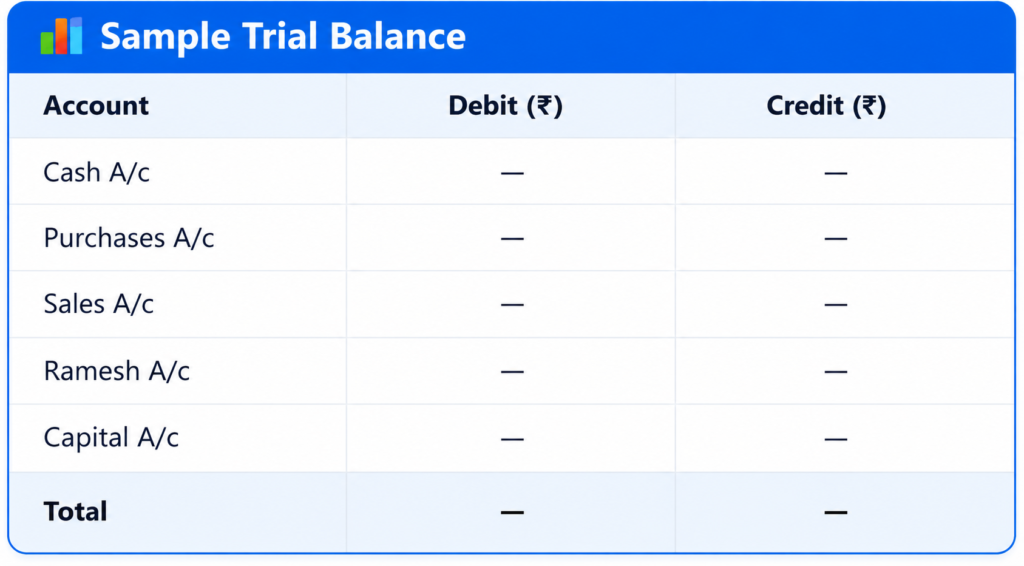
After posting all entries to the Ledger, prepare a Trial Balance — a list of all
accounts with their debit or credit balance. The purpose is to verify that
Total Debits = Total Credits.

Final Accounts — Three Key Statements

📈
Trading Account
Shows Gross Profit = Sales minus Cost of Goods Sold.
💹
Profit & Loss Account
Shows Net Profit = Gross Profit minus all operating expenses.
🏦
Balance Sheet
Snapshot of the business showing all Assets = Liabilities + Capital on a specific date.

Day-to-Day Accounts Maintenance Best Practices

Proper accounts maintenance is not just about recording entries — it's about consistent habits that keep your books accurate and audit-ready:

Daily Accounts Maintenance — Best Practices

Record daily • Reconcile bank • Track GST • Audit-ready books

1. Record Transactions Daily

Enter every transaction on the same day it happens. Never leave bookkeeping entries for later — this is the #1 rule for clean accounts.

2. Keep All Source Documents

Always attach bills, invoices, receipts, and bank slips to your records. These are required for GST audits and income tax assessments.

3. Monthly Bank Reconciliation

Compare your Cash Book with your bank statement every month. This process — called Bank Reconciliation — catches errors and prevents fraud.

4. Track Debtors & Creditors

Maintain a separate ledger for each debtor (who owes you) and creditor (who you owe). Know exactly how much is outstanding at all times.

5. File GST Records Accurately

In India, every transaction must include GST Input Tax Credit (ITC) and Output Tax. Accurate bookkeeping makes your GSTR-1 and GSTR-3B filing effortless.

Common Bookkeeping Mistakes to Avoid

Even experienced accountants make these errors. Knowing them helps you catch and
correct them early:
Error of Omission: A transaction is completely forgotten and not recorded at all.
Always double-check your daily entries.
Error of Commission: Entry made in the wrong account — for example, posting to Ramesh's account instead of Suresh's. Verify names carefully.
Error of Principle: A capital expense (like buying a computer) recorded as a revenue expense. Know the difference between capital and revenue items.
Compensating Error: Two errors cancel each other out — the Trial Balance still balances, but both entries are wrong. Requires careful analysis to catch.
Transposition Error: Digits are reversed — ₹5,400 entered as ₹4,500. Always cross-check amounts against source documents.

Frequently Asked Questions — Bookkeeping

❓ What is the difference between bookkeeping and accounting?

Bookkeeping is the process of recording financial transactions. Accounting involves interpreting, analyzing, and reporting those records. Bookkeeping is the first step — accounting builds on it. SNR TaxCare provides both services for businesses of all sizes.

❓ Is bookkeeping mandatory for small businesses in India?

Yes. Under the Income Tax Act and GST Law in India, businesses above a certain turnover threshold must maintain proper books of accounts. Even below the threshold, maintaining accounts is strongly recommended for business health and loan eligibility.

❓ How often should I update my books of accounts?

Ideally, update your bookkeeping entries daily. At minimum, update them weekly. Delaying entries leads to errors, missing documents, and compliance issues during GST filing or tax assessments.

❓ Can SNR TaxCare help with bookkeeping and accounts maintenance?

Absolutely! SNR TaxCare offers professional bookkeeping, ledger maintenance, GST reconciliation, and annual accounts finalization services. Contact us today for a free consultation.

🚀 Need Professional Help with Your Bookkeeping?

Let SNR TaxCare handle your accounts — accurate, timely, and 100% compliant with Indian tax laws. Free consultation for new clients!

📞 Talk to an Expert

Free 30-minute consultation for your bookkeeping needs.
Scroll to Top