
Tax Compliance · Updated for FY 2026
TDS Return Filing, explained
one deadline at a time
A TDS return is the quarterly statement every deductor owes the Income Tax Department. Miss it, and the penalties compound daily. This guide walks through every form, rate and due date you need to file your TDS return correctly — the first time.
On this page
1. What is TDS?
2. Who's involved in TDS
3. What is a TDS return
4. TDS return forms
5. Quarterly due dates
6. A worked example
7. Penalties for late filing
8. Key TDS sections & rates
7. FAQs
01 · The basics
What is TDS, and why does a TDS return matter?
TDS stands for Tax Deducted at Source. Whenever a payment is made — salary, rent, a professional fee, a contractor's invoice — the person paying deducts a fixed percentage of tax before the money reaches the receiver, and deposits that amount directly with the Government of India.
Instead of waiting for a taxpayer to settle up at year-end, the government collects tax at the exact moment the payment happens.
That deduction is only half the story. Every deductor must also file a TDS return — a quarterly statement that tells the Income Tax Department exactly who was paid, how much was deducted, and when it was deposited.
Skip the deduction and you owe interest. Skip the TDS return and you owe a daily penalty, regardless of whether the tax itself was paid correctly.
02 · The three parties
Who's involved in TDS
Every TDS transaction has three sides to it, and a TDS return is essentially the paper trail that connects them.
Pays & deducts
Deductor
The employer or company making the payment. Responsible for deducting tax, depositing it, and filing the TDS return.
Receives
Deductee
The employee, vendor or contractor being paid — receives the net amount after TDS is cut, and claims credit for it later.
Collects
Government
The Income Tax Department, which receives the deposited tax and matches it against the deductee's Form 26AS.
03 · The document itself
What is a TDS return, exactly?
A TDS return is a quarterly statement the deductor files with the Income Tax Department, listing every payment made and every rupee of tax deducted and deposited during that quarter.
It's filed online through the TRACES / Protean (formerly TIN-NSDL) portal, using a form that depends on the type of payment. Here's the full cycle, from the moment a payment is made to the point a deductee claims credit for it:
01
Payment
Salary, rent or a fee is paid to the deductee.
02
TDS deducted
A fixed % is withheld before payment.
03
Deposited
Paid to govt. via Challan 281 by the 7th.
04
TDS return filed
Quarterly statement filed on TRACES.
05
Form 16/16A issued
Deductee gets proof of TDS for their ITR.
04 · Which form applies
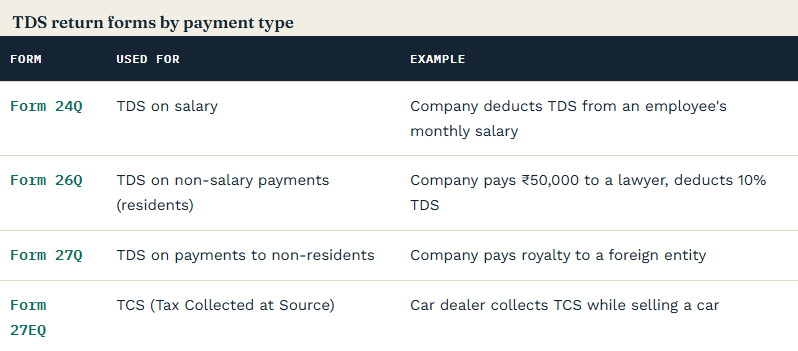
TDS return forms — which one do you file?
The correct TDS return form depends entirely on what kind of payment was made. Filing the wrong form is one of the most common reasons a TDS return gets rejected on TRACES.
05 · The compliance calendar
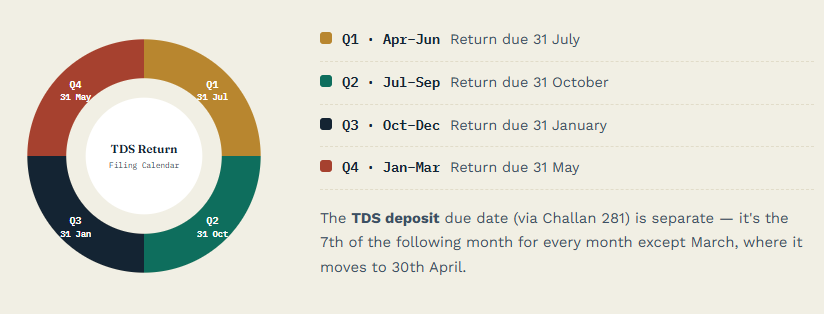
Quarterly due dates for filing a TDS return
A TDS return is a recurring, cyclical obligation — four filings a year, every year, tied to the same quarters as your books. This calendar shows where each quarter's TDS return falls due:
06 · A worked example
Filing a TDS return, step by step
ABC Pvt. Ltd. pays a monthly salary of ₹1,00,000 to its employee, Ravi. Here's exactly how that flows into a TDS return.
1. Payment
ABC Pvt. Ltd. pays Ravi his monthly salary of ₹1,00,000.
2. TDS deducted
Based on Ravi's slab, ABC deducts ₹20,000 as TDS. Ravi receives ₹80,000 in hand.
3. Deposited to government
ABC deposits ₹20,000 with the Income Tax Department by the 7th of the next month, using Challan 281.
4. Quarterly TDS return filed
At the end of Q1, ABC files Form 24Q on TRACES by 31st July, listing every employee's salary and TDS for the quarter.
5. Form 16 issued
After the financial year ends, ABC issues Form 16 to Ravi by 15th June, summarising the year's salary and TDS.
6. Ravi files his ITR
Ravi checks his Form 26AS, sees ₹2,40,000 credited for the year, and offsets it against his tax liability — claiming a refund if too much was deducted.
07 · What's at stake
Penalties for late or missed TDS return filing
Delays compound quickly, and each stage of non-compliance carries its own penalty — separate from the tax itself.
1% / month
Interest if TDS is not deducted at all on a payment that required it.
1.5% / month
Interest if TDS was deducted but not deposited with the government.
₹200 / day
Late fee under Section 234E for filing the TDS return after its due date, capped at the total TDS amount.
₹10,000–₹1,00,000
Minimum penalty under Section 271H if the TDS return isn't filed at all.
08 · Rates & thresholds
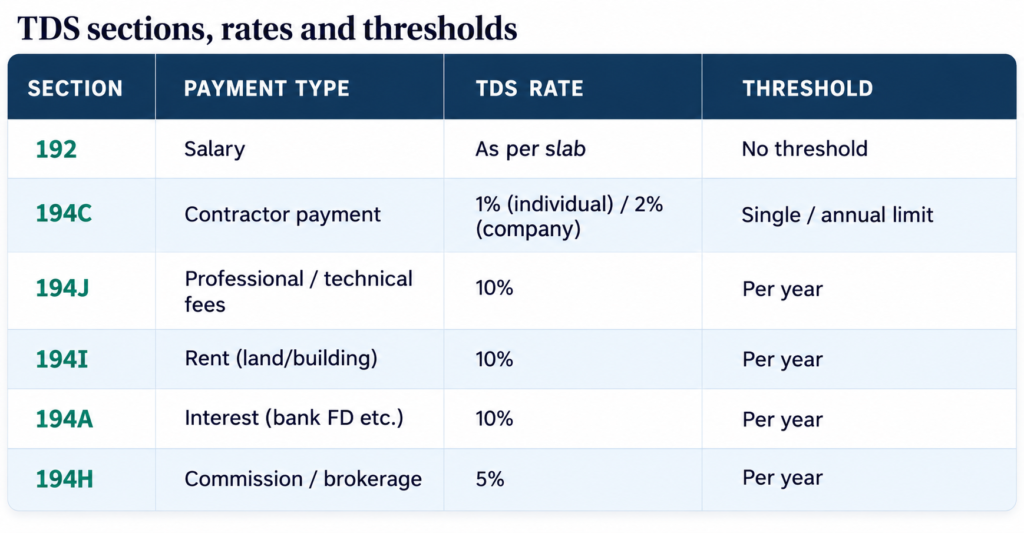
Key TDS sections you'll actually run into
09 · In short
Summary
TDS is a mechanism for collecting tax at the point of payment rather than waiting for year-end. The deductor deducts tax, deposits it monthly via Challan 281, and files a quarterly TDS return — Form 24Q, 26Q or 27Q — on the TRACES portal.
Filing your TDS return on time keeps the deductee's Form 26AS accurate, avoids interest under Sections 234E/271H, and keeps your business off the department's compliance radar.
For the official rules and portals referenced in this guide, see:
10 · Quick answers
Frequently asked questions
Who needs to file a TDS return?
Any deductor — an employer, company or individual required to deduct tax at source — must file a quarterly TDS return once they've deducted TDS on salary, contractor payments, professional fees, rent, interest or commission.
Can a TDS return be revised after filing?
Yes. A correction statement can be filed on TRACES to fix errors in PAN, challan details or deducted amounts in an already-filed TDS return.
What's the difference between the TDS deposit date and the TDS return date?
The deposit (via Challan 281) is monthly, due by the 7th of the next month. The TDS return itself is quarterly, summarising all deposits and deductions for that quarter.
Do I still need to file a TDS return if no tax was deducted in a quarter?
If there were no deductions in a quarter, a NIL TDS return isn't mandatory, but it's good practice to file a declaration on TRACES to avoid automated non-filing notices.
Let SNR Tax Care file it for you
Forms, challans, due dates, corrections — we handle the full TDS return cycle so you don't have to track it.
Ready to Get Started? Let's Talk Today
Looking for a reliable Tax Consultant in Visakhapatnam? Contact SNR TaxCare today for expert tax and compliance support.
- +91 996 666 5334
- +91 703 666 5334
- snrtaxcare5334@gmail.com
- Monday – Saturday: 9:00 AM – 7:00 PM