
Accounting Basics · Payroll
Payroll Accounts, Explained
With One Real Payslip
Every rupee an employee earns, and every rupee the employer pays on top, passes through a Payroll Account before it reaches the books. Here is the full path, in 7 steps, with one worked example you can reuse.
On this page
1. What is Payroll?
2. The 7-step payroll process
3. Key payroll ledger accounts
4. Worked example summary
5. FAQ
6. Get help with payroll
Definition
What Are Payroll Accounts?
Payroll is how a company works out and pays what it owes its employees — salary, deductions, and the extra contributions the employer adds on top of every payment. Payroll Accounts are the specific ledger entries and journal records a company keeps so that every one of those amounts is traceable: what was earned, what was withheld, what was paid out, and what the company itself contributed.
Get the Payroll Accounts right and a business never has to guess where money went. Get them wrong and a single missed Provident Fund entry can turn into a compliance problem months later.
Walkthrough
The 7-Step Payroll Process
We'll follow one employee, Ravi Kumar, a Sales Executive, through every stage of Payroll Accounts — from his attendance sheet to the bank transfer.
Step 1 —
Collect Employee Data
Before any Payroll Accounts entry can be made, HR gathers the basics: name, designation, salary structure, bank account, PAN, attendance, and outstanding loans.
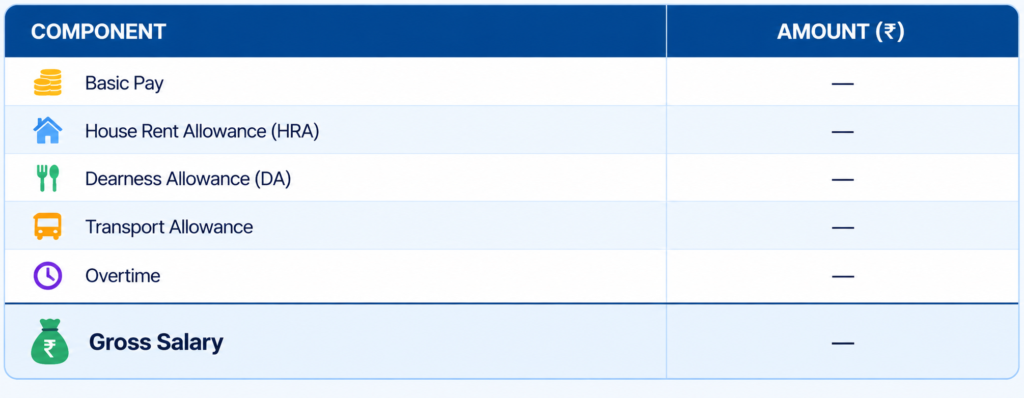
Example — Ravi Kumar, Sales Executive. Basic ₹30,000, HRA ₹10,000, DA ₹5,000, Transport ₹2,000. Present 26/26 working days.
Step 2 —
Calculate Gross Salary
Gross Salary is the full amount agreed before anything is subtracted: Basic Pay + HRA + DA + Allowances + Overtime.
Step 3 —
Apply Deductions
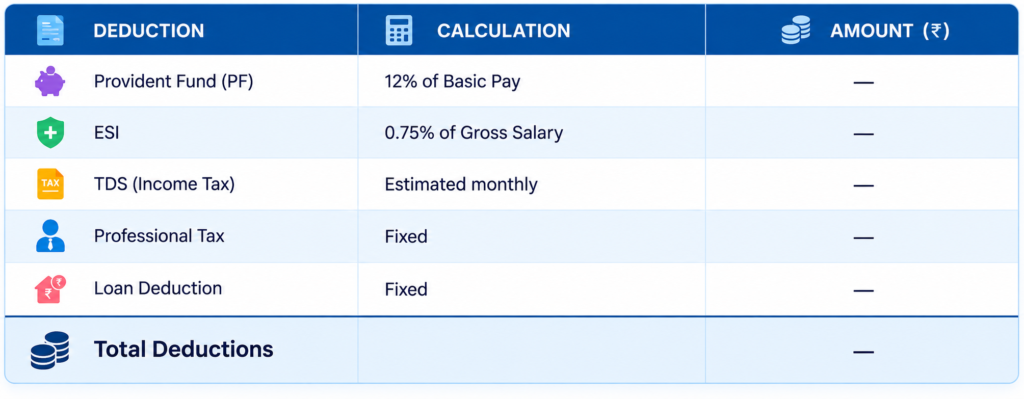
Deductions split into two kinds. Statutory deductions are required by law: Provident Fund (12% of basic), ESI (0.75% of gross), TDS, and Professional Tax. Voluntary deductions cover loan repayments, advances, or canteen charges.
Step 4 —
Calculate Net Salary
Net Salary is the take-home figure: Gross Salary − Total Deductions = ₹50,000 − ₹7,500 = ₹42,500. That ₹42,500 is what lands in Ravi's account on salary day, and it's the number his payslip leads with.
Step 5 —
Employer Contributions
Separate from anything deducted from Ravi's pay, the employer adds its own share on top. These never touch the employee's payslip — they're a direct company cost.
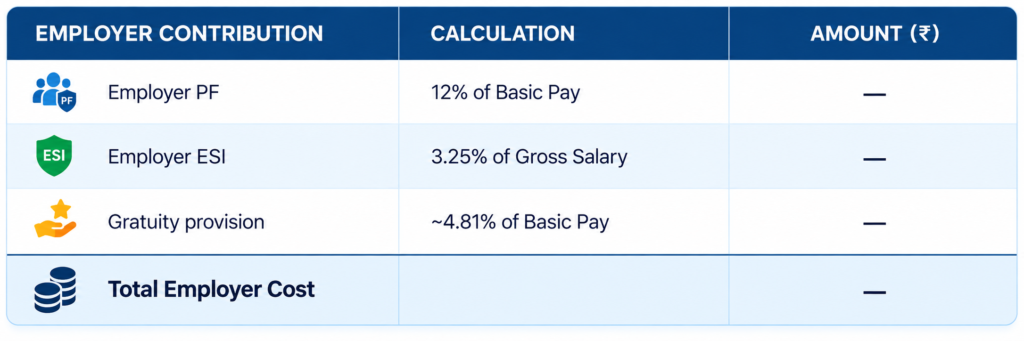
True cost of Ravi to the company: ₹50,000 + ₹6,668 = ₹56,668 per month.
Step 6—
Pay the Employee
On salary day, the net amount is transferred by NEFT or IMPS and a payslip is shared. The withheld amounts — PF, ESI, TDS — are sent on to the relevant government departments by their own due dates: PF by the 15th of the next month, TDS by the 7th.
Step 7—
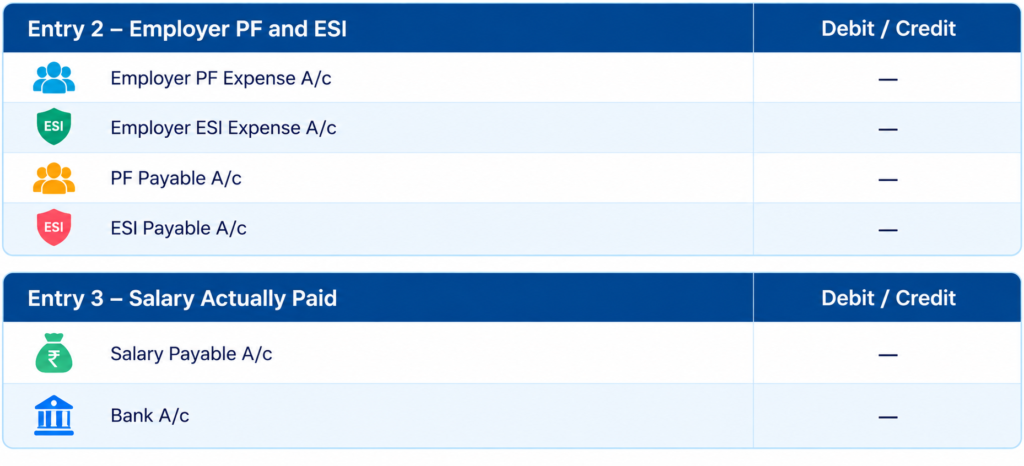
Record the Payroll Accounts Journal Entries
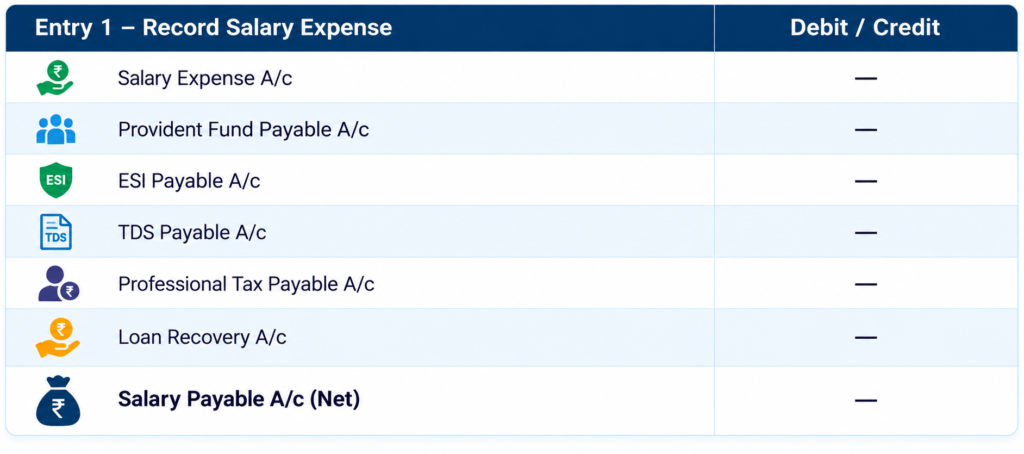
This is where Payroll Accounts actually live — in the books. Three entries cover the whole cycle.
Reference
Key Payroll Accounts in the Ledger
Three groups of Payroll Accounts cover everything above:
1. Expense accounts (debit side): Salary Expense, Bonus Expense, Employer PF Expense, Employer ESI Expense, Gratuity Expense.
2. Liability accounts (credit side): Salary Payable, PF Payable, ESI Payable, TDS Payable, Professional Tax Payable, Advance Salary Payable.
3. Asset accounts: Bank Account, credited the moment salary actually leaves the company.
Related reading on SNR Tax Care
Worked Example
Ravi's Payroll Accounts, Start to Finish
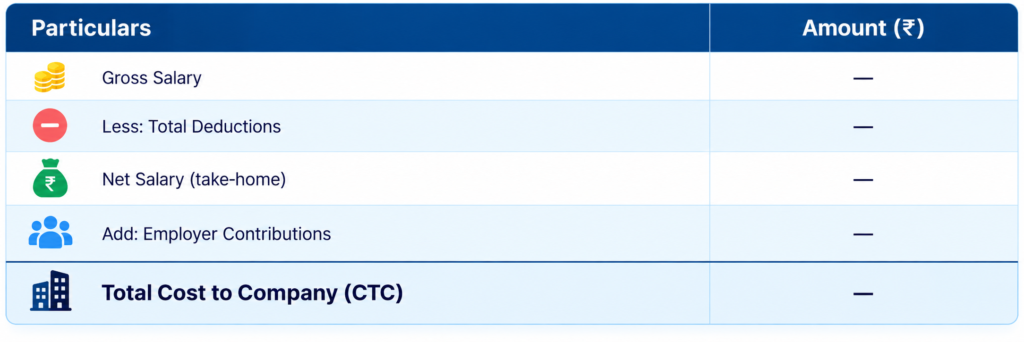
That single table is Payroll Accounts in miniature: what the employee sees, what the company actually spends, and the gap between the two that every Payroll Account exists to track.
FAQ
Common Questions on Payroll Accounts
Is Provident Fund deducted from the employee, the employer, or both?
Both. The employee's 12% PF share is withheld from salary; the employer pays a matching 12% separately, recorded as its own Employer PF Expense.
Where can I check the current PF and ESI rates?
What's the difference between Gross Salary and CTC?
Gross Salary is what shows on the payslip before deductions. CTC (Cost to Company) adds the employer's own contributions on top, so it's always the larger number.
Where do TDS rules come from?
Next Step
Let SNR Tax Care Run Your Payroll Accounts
Manually re-checking PF, ESI, TDS, and journal entries every month is where most small businesses lose hours — or make errors that surface at audit time. SNR Tax Care sets up and maintains Payroll Accounts so each payslip, each contribution, and each journal entry is correct the first time.
Ready to Get Started? Let's Talk Today
Looking for a reliable Tax Consultant in Visakhapatnam? Contact SNR TaxCare today for expert tax and compliance support.
- +91 996 666 5334
- +91 703 666 5334
- snrtaxcare5334@gmail.com
- Monday – Saturday: 9:00 AM – 7:00 PM