
Firm Registration · India · 2026
Partnership Firm Registration,
made easy — the complete 11-step guide
Partnership Firm Registration is the foundation every trading, services, or family business needs before it can sue, borrow, or hold a trademark in its own name. SNR TaxCare walks you through the deed, the documents, the stamp duty, and the Registrar of Firms — start to finish.
- Expert CA Assistance
- Starting ₹4,999
- Fast Processing
What is a Partnership Firm?
Partnership Firm Registration begins with understanding the structure itself. A partnership firm is formed when two or more people come together to run a business and share its profits in an agreed ratio, governed in India by the Indian Partnership Act, 1932.
A firm needs a minimum of 2 partners and can have up to 50 partners, and there is no minimum capital requirement — which is exactly why so many small trading and services businesses choose this structure over a private limited company.
Key Rules at a Glance
- Governed by Indian Partnership Act, 1932
- Minimum 2 — Maximum 50 partners
- Written Partnership Deed is essential
- Unlimited liability of partners
- Profit sharing as per deed terms
- Flat 30% income tax on firm profits
- Registration with ROF is optional but recommended
Benefits of Registering Your Partnership Firm
Stronger legal standing, easier credit, and long-term flexibility.
Legal Protection
Enforceable rights under the Partnership Act, 1932.
Bank Loan Eligibility
Easier access to current accounts and credit.
Sue in Court
Registered firms can file suits against third parties.
Legal Protection
Apply for trademarks in the firm's name.
Low Cost
Affordable setup compared to LLP or Pvt Ltd.
Flexible Structure
Customize roles, capital, and profit sharing freely.
Documents Required
Keep these ready to fast-track your registration.
PAN Card of all partners
Aadhaar Card of all partners
Partnership Deed (we draft it)
Passport-size photos
Address proof of firm
NOC from landlord (if rented)
Affidavit on stamp paper
Form 1 (Application)
Passport / Driving License
The complete Partnership Firm Registration process
Eleven sequential steps — in the order the Registrar of Firms expects to see them.
01
Choose a Business Name
Pick a unique name. Words like King, Crown, Empire, Royal, India, National, Bank, or State are prohibited in a firm name.
- "Sharma & Sons Trading Firm"
- "India National Trading Co."
02
Choose a Business Name
Pick a unique name. Words like King, Crown, Empire, Royal, India, National, Bank, or State are prohibited in a firm name.
03
Decide the Partnership Terms
Before drafting anything, partners must agree on capital contribution, profit/loss ratio, individual roles, salary or commission, and rules for exit or dissolution.
04
Draft the Partnership Deed
The deed records the firm's name and address, partner details, commencement date, capital, and profit-sharing ratio. Have it drafted by a lawyer (₹1,000–₹3,000) — a self-drafted deed often has loopholes.
05
Print on Stamp Paper & Notarize
The deed must be executed on stamp paper no older than six months, then verified by a Public Notary. Stamp duty ranges roughly ₹200–₹10,000 depending on the state and capital.
- Tamil Nadu — ~₹300 flat
- Delhi / Maharashtra — ₹500–₹5,000, capital-based
- Notary charges — ₹200–₹1,000
06
Collect the Required Documents
Notarized deed, Form 1 application, an affidavit of intent, address proof of the firm, and ID/address proof (PAN, Aadhaar) for every partner.
07
Submit to the Registrar of Firms
File Form 1 with the deed and documents at the Registrar of Firms for the state where the firm's principal office sits, per Section 58 of the Indian Partnership Act, 1932. Some states allow this online.
08
Pay the Registration Fee
The official fee generally falls between ₹500 and ₹2,000, paid by challan or demand draft to the Registrar.
09
Registrar Verifies & Issues the Certificate
Once documents are verified, the firm is entered into the Register of Firms and the Certificate of Registration is issued — typically within 10 to 14 working days.
10
Apply for the Firm's PAN & TAN
PAN is filed in Form 49A and TAN in Form 49B — both distinct from any individual partner's personal PAN, and both needed before you can bank or file tax returns as a firm.
11
Open a Current Bank Account
With the Certificate of Registration and firm PAN in hand, open a current account to separate business and personal finances — a step banks and auditors will expect.
12
Register for GST, if applicable
Mandatory once annual turnover crosses ₹20 lakh or ₹40 lakh, depending on the state and type of supply. Below that threshold, it's optional.
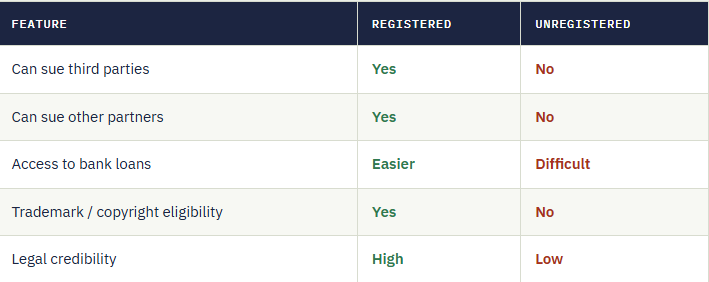
Registered vs. unregistered firms
Staying compliant after registration
Partnership Firm Registration isn't a one-time event — the Registrar and the tax department expect ongoing upkeep.
- File the firm's Income Tax Return every year (partnerships are taxed at a flat 30%).
- File GST returns monthly or quarterly, if GST-registered.
- Maintain proper books of accounts.
- Deduct and deposit TDS where applicable.
- Notify the Registrar of any change — new partner, address, or dissolution — via Form 2.
Partnership Firm Registration — FAQs
Is Partnership Firm Registration mandatory in India?
No, but an unregistered firm loses the right to sue third parties or its own partners, and cannot hold a trademark —
which makes registration effectively essential for any serious business.
which makes registration effectively essential for any serious business.
How long does Partnership Firm Registration take?
Most states issue the Certificate of Registration within 10 to 14 working days after the Registrar verifies your documents,
though timelines vary by state.
though timelines vary by state.
Do I need a lawyer to draft the deed?
It isn't legally required, but a professionally drafted deed (typically ₹1,000–₹3,000) avoids the loopholes that commonly appear in self-drafted agreements.
Ready to Get Started? Let's Talk Today
Looking for a reliable Tax Consultant in Visakhapatnam? Contact SNR TaxCare today for expert tax and compliance support.
- +91 996 666 5334
- +91 703 666 5334
- snrtaxcare5334@gmail.com
- Monday – Saturday: 9:00 AM – 7:00 PM